




















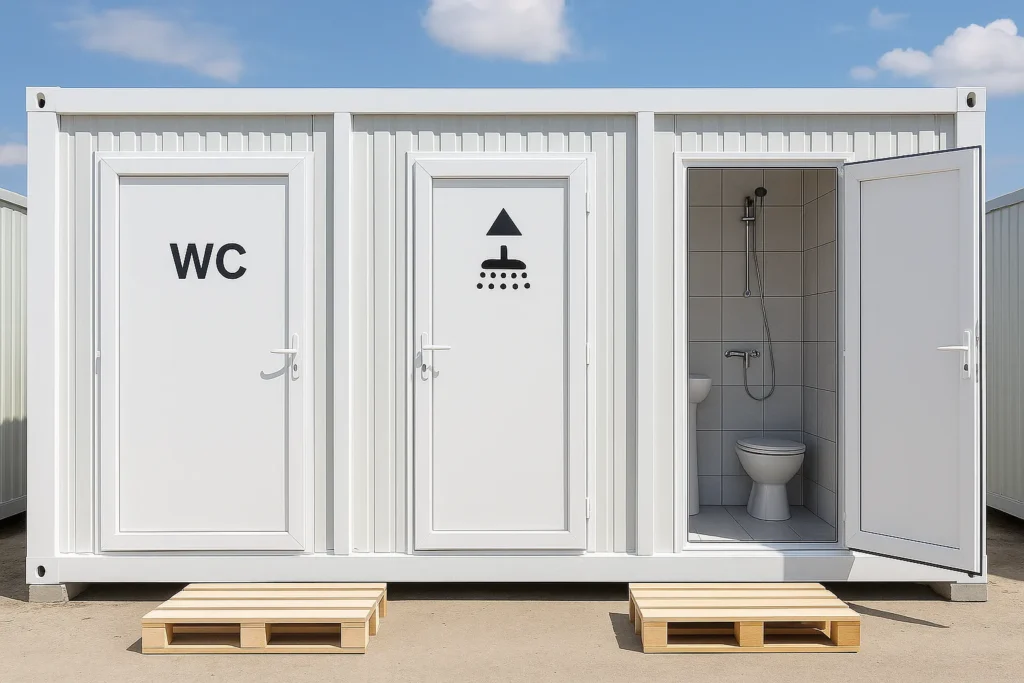
WC, Toilet and shower units: Sanitary Containers Built for Hygiene
What Are Sanitary Containers?
These are prefabricated modules that integrate toilets, urinals, washbasins and showers inside an insulated steel shell. Interiors arrive finished: non-porous wall panels, anti-slip floors with coving, LED lighting, mirrors, hand dryers and dispensers. Units can be configured as male/female sections, accessible cabins, family rooms with baby change, or staff-only facilities. Because the fit-out is done at the factory, quality is consistent and commissioning is faster.
Why Choose Containers for Hygiene Facilities
- Rapid deployment: ground prep and utility connections happen in parallel with factory production.
- Mobility: relocate the same asset as projects move—no need to rebuild services each time.
- Scalability: add or subtract modules to match headcount and peak event times.
- Predictable standards: repeatable details make cleaning easier and inspections smoother.
Design & Engineering Essentials
- Materials: powder-coated steel frames, hygienic HPL or GRP wall liners, stainless fixtures and moisture-resistant substrates.
- Thermal comfort: insulated envelope plus electric or heat-pump HVAC to prevent condensation.
- Flooring: slip-resistant vinyl or resin with coved skirtings for easy wash-down.
- Accessibility: widened doors, grab rails, low-threshold showers and turning circles.
- Privacy & flow: vestibules, occupancy indicators and acoustic separation for a better user experience.
Water, Waste & Ventilation
Plumbing manifolds and hot-water systems are pre-tested. Sites with limited services can run from fresh-water tanks and holding tanks for black/grey water, with quick-connect couplings for pumping. Where sewer connections exist, a simple tie-in minimizes setup time. Mechanical extract keeps humidity and odours under control; in cold climates, heat-recovery ventilation improves efficiency.
For sustainability, specify dual-flush WCs, aerated taps and timer showers. Leak-detection sensors and shut-off valves reduce water loss, while solar-ready rooftops provide space for future PV if power demand grows.
Where They’re Used
- Construction & mining compounds: robust, easy-clean facilities for crews working in shifts.
- Events & festivals: higher-comfort alternatives to chemical toilets, with better throughput.
- Sports & recreation: clubhouses, poolside showers and seasonal beach amenities.
- Municipal & relief operations: emergency shelters, border posts and temporary town services.
- Education & healthcare: decant projects during refurbishments and expansion phases.
Cost Drivers & Budget Tips
Total price varies with size, number of fixtures, hot-water demand, HVAC capacity, finish grade and logistics. Dry WC blocks are most economical; adding showers, changing bays and accessible rooms increases capex but improves welfare and compliance. Consider lifetime value: durable materials, water-saving fixtures and easy-wash surfaces reduce operating costs and cleaning time.
- Plan utilities early: confirm power (amps), water pressure and drainage routes.
- Right-size hot water: choose tank or instantaneous heaters based on peak users.
- Protect high-wear zones: kick plates, PVC corner guards and heavy-duty door hardware.
Fast Answers
Are sanitary containers permanent? Many operate for years and can be relocated as needs change.
Can they run off-grid? Yes—fresh/holding tanks, generators or solar-hybrid kits keep units functional where services are absent.
How quickly can we open? Often within days once foundations/pads and utilities are ready.
What about cleaning? Smooth, non-porous finishes and floor drains make daily wash-down simple.
Practical Takeaways
Sanitary containers combine factory quality with rapid setup to deliver hygienic WC, toilet and shower facilities anywhere. Prioritise robust materials, efficient ventilation and water-saving fixtures, and insist on a clear, itemised scope. The result is a reliable, easy-to-maintain amenity that scales with headcount and keeps users comfortable through every season.


