




















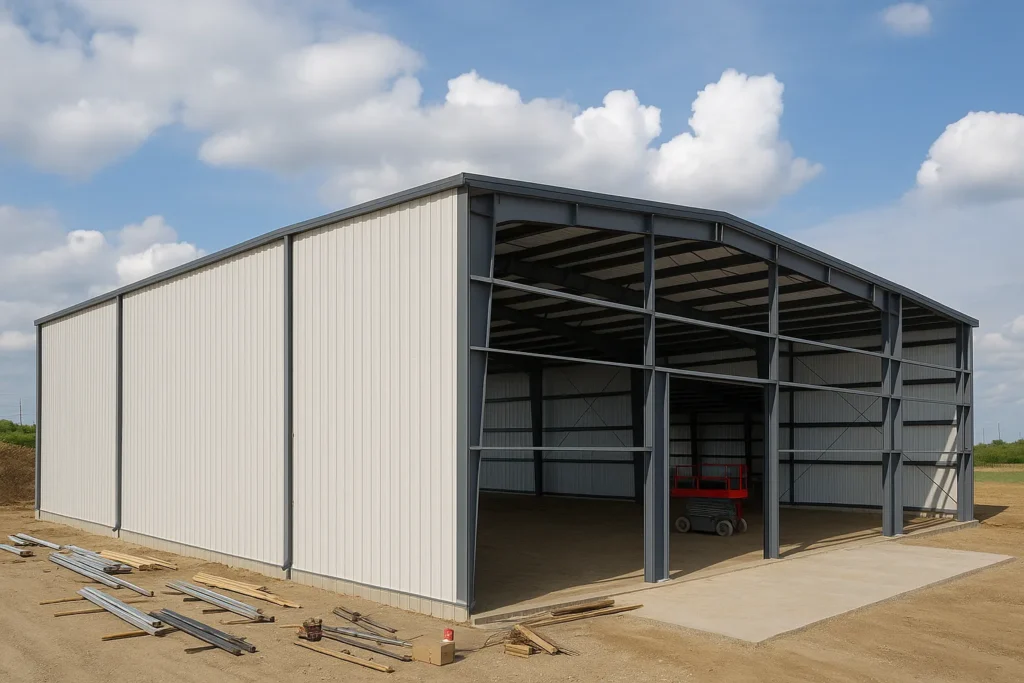
What Defines a Prefabricated Steel Building?
A prefabricated steel building consists of structural members (columns, rafters, trusses), secondary steel, bracing and cladding elements manufactured off-site. Many metal building kits arrive pre-cut and pre-drilled with fasteners and connection details included. On site, the main tasks are positioning, bolting or welding, and then enclosing the structure with roof and wall systems.
Depending on the supplier, kits may be delivered as frame-only, frame + envelope, or with additional doors, windows and accessories. Mechanical, electrical and interior fit-out are typically project-specific.
Why Choose Steel?
Strength with Flexibility: Steel’s strength-to-weight ratio enables large spans and open interiors, reducing the need for frequent columns—useful in logistics halls, showrooms and sports facilities.
Faster Assembly: With fabrication handled at the factory, site teams focus on assembly. Pre-drilled connections and standardised details can speed up erection.
Longevity: With appropriate corrosion protection and periodic maintenance, steel structures can offer long service life.
Adaptability: Modular framing allows extensions, alterations or changes in internal layout. Some systems anticipate future expansion bays.
Sustainability Potential: Steel is recyclable. Factory precision reduces waste, and modern envelopes can improve energy performance when paired with good detailing.
From Factory Floor to Building Site
Concept & Digital Design: Loads, bracing strategy, wind/snow data and envelope targets are modelled with CAD/BIM tools.
Fabrication: Primary members and secondary steel are cut, drilled and treated in controlled conditions.
Logistics: Components are packaged for efficient shipping; unloading sequence mirrors the erection sequence where possible.
Assembly: Frames, purlins and bracing are installed; roofing and wall systems are fixed.
Fit-Out & Commissioning: Openings, doors, ventilation, lighting and MEP complete the scope.
Typical Applications of Metal Building Kits
Warehouses & Logistics Centres: Wide spans and high eaves for racking and vehicle movement.
Agricultural Facilities: Barns, feed storage, processing halls and sheltered yards.
Retail & Showrooms: Open plans with glazed façades and branded cladding.
Sports & Recreation: Gyms, courts, arenas and pool enclosures.
Industrial Workshops: Fabrication bays, repair shops and small manufacturing lines.
Hybrid/Residential Frameworks: Light-gauge steel systems adapted for modular living and mixed-use spaces.
What Affects the Cost of Prefabricated Steel Buildings?
Steel Prices: A global commodity that fluctuates with supply and demand.
Size & Geometry: Larger spans, higher eaves and complex rooflines require more steel and detailing.
Envelope & Insulation: Fire-rated systems, insulated sandwich panels and daylighting features affect budgets.
Logistics & Access: Transport distances, crane availability and site constraints influence cost.
Groundworks & Utilities: Foundations, drainage and connections are often outside the base kit price.
Compliance & Documentation: Calculations, inspections and certifications vary by jurisdiction.
Scope clarity matters: Confirm whether the offer includes frame only, frame + cladding, or a more complete package with doors, windows and accessories.
Technical Considerations
Corrosion Protection: Galvanisation, epoxy or duplex coatings suited to exposure and environment.
Fire Strategy: Intumescent coatings or layered assemblies where required.
Thermal Bridges: Detail junctions to limit heat loss and condensation risk.
Airtightness & Weathering: Compatible membranes, seals and fixing systems.
Roof Drainage: Falls, outlets and overflow provision sized for local rainfall.
Acoustics: Partition build-ups for target dB levels in multi-use buildings.
MEP Coordination: Cable trays, ducts and plant access clearances.
Warranty & Aftercare: Coverage for structure, envelope and workmanship.
Sustainability & Environmental Aspects
- Factory precision can limit off-cuts and waste.
- Steel is recyclable, supporting circularity goals.
- Large roofs are well-suited to solar PV integration.
- “Fabric-first” envelopes can reduce operational energy use.
Common Misconceptions
“They’re temporary by default.” Many systems are designed for decades with routine maintenance.
“All look the same.” Cladding, glazing and façade articulation allow varied aesthetics.
“Always cheaper.” Savings depend on scope, logistics and specification.
“No permits required.” Most permanent buildings require planning and compliance checks.
Expanding Use Cases
E-commerce hubs: Rapid deployment near urban areas.
Renewable energy support: Housings for turbines, inverters and battery storage.
Community facilities: Sports halls, clinics and multi-purpose venues.
Mixed-use shells: Retail + storage combinations with flexible bays.
Conclusion
Prefabricated steel buildings and metal building kits offer an approach that blends speed, adaptability and predictable quality. They are not a universal answer, but for many warehouses, workshops, community venues and hybrid spaces, they provide a compelling path from concept to completion. Because projects differ widely, comparing scopes carefully, confirming compliance obligations and planning maintenance remain sensible steps before committing.
Information-only notice: This article shares general insights and is not legal, financial, technical or planning advice. Outcomes vary by supplier, site and local regulation.


