




















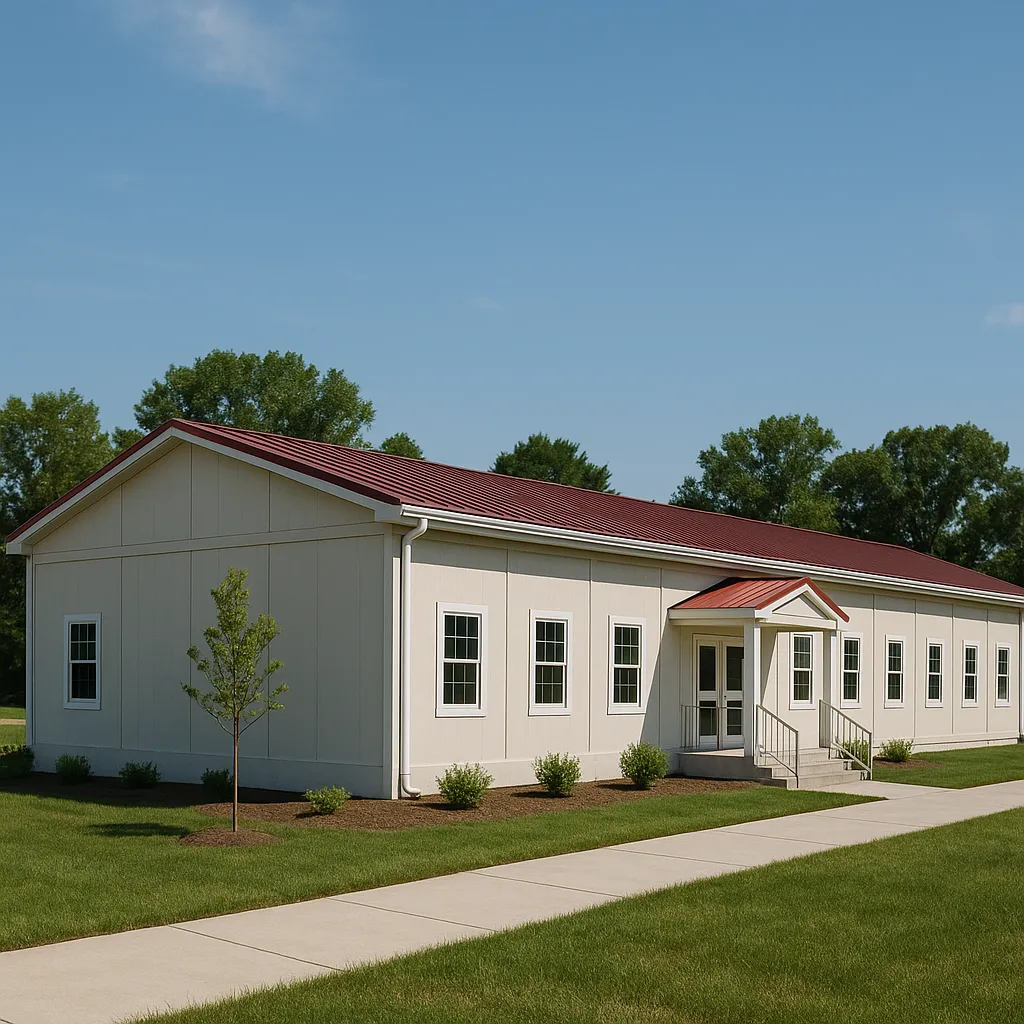
What Are Prefabricated Social Buildings
Prefabricated social buildings are modular structures designed for public and community uses. Typical programs include:
- Schools and classrooms: general teaching spaces, labs, libraries and administration.
- Healthcare units: primary care clinics, diagnostics, dental rooms and first aid suites.
- Cultural and community venues: multipurpose halls, rehearsal rooms, exhibition areas and reading rooms.
Instead of traditional on-site construction, key components are produced off-site and delivered as volumetric modules or panelized systems. On site, the focus shifts to installation, fit-out and commissioning, often shortening timelines.
Why Prefabricated Social Buildings Matter in 2025
Rapid deployment when timing is critical
After population shifts or disruptive events, communities need classrooms and clinics quickly. Prefabrication compresses early construction activities so essential services can begin sooner.
Accessibility for remote or underserved areas
Transportable modules enable delivery in challenging locations. This can improve equity in access to education and healthcare.
Predictable budgets
Factory workflows reduce waste and variability. Municipalities and donors can plan around clearer cost baselines, even though compliance and logistics still influence totals.
Room to grow
Modular layouts allow phased expansion—adding classrooms, treatment rooms or community spaces as demand increases.
Quality and safety
Standardized production supports consistent quality. Reputable suppliers design for fire safety, structural performance and accessibility requirements common to public buildings.
Core Programs and Layouts
Good social infrastructure is more than floor area. Circulation, adjacencies and environmental comfort affect outcomes. Common planning patterns include:
- Schools: clusters of classrooms around shared resources such as libraries and labs, with staff spaces and sanitary cores placed for easy supervision.
- Clinics: clear patient flows from reception to consultation and treatment rooms, including accessible WCs and clean utility areas.
- Community centers: a multipurpose hall at the heart, supported by flexible meeting rooms, storage and catering facilities.
Early definition of capacity, hours of use and peak loads helps right-size modules, entrances and plant areas.
Systems and Materials
The performance of prefabricated social buildings depends on structure, envelope and fit-out choices. Typical options include:
- Frames: light steel, engineered timber or hybrids selected for durability, speed and local supply.
- Envelopes: insulated sandwich panels or high-performance façades targeting comfort and energy efficiency.
- Openings: robust doors and windows with shading and security where needed.
- Interior partitions: demountable walls for reconfiguration without major works.
- Finishes: easy-clean surfaces, slip-resistant flooring and acoustic treatments for teaching and clinical privacy.
From Concept to Opening
- Brief and feasibility: define user needs, capacity, accessibility and compliance targets.
- Design and coordination: plan structural grids, MEP routes and fire strategy with BIM or CAD tools.
- Factory production: fabricate frames, panels and service modules in controlled conditions.
- Logistics and installation: schedule deliveries, cranes and site access; assemble modules and envelope.
- Fit-out and commissioning: install furniture, specialist equipment and test building systems.
Tip: Align delivery with permitting and utility connections. A clear method statement and handover checklist help avoid delays.
Cost Drivers and Budget Planning
Prefabrication can control costs, but totals vary with scope and location. Key drivers include:
- Size and complexity: multi-storey schools or clinical suites require more structure and services.
- Specification: insulation levels, acoustic privacy, medical gases and ICT raise performance and cost.
- Compliance: fire resistance, accessibility and hygiene standards add materials and documentation.
- Logistics: transport distance, crane requirements and site constraints influence installation budgets.
- Duration and intensity of use: higher durability finishes may pay off for long operating hours.
Scope clarity matters: confirm whether offers include foundations, utility connections, furniture and equipment, or if they are frame-and-envelope only.
Sustainability and Community Impact
Public buildings should be efficient to operate and comfortable to use. Prefabricated social buildings can support these goals by:
- Reducing construction waste through factory precision.
- Improving thermal comfort with well-detailed envelopes and airtightness.
- Lowering operational costs by integrating solar PV and efficient HVAC.
- Minimizing neighborhood disruption thanks to shorter on-site periods.
Responsible end-of-life planning—disassembly, reuse and recycling—enhances long-term sustainability.
Use Cases and Deployment Scenarios
- Rapid school expansions: modular classroom clusters added before a new term.
- Primary care access: clinics delivered to growing suburbs or rural areas.
- Cultural hubs: multipurpose halls for events, youth programs and elder care activities.
- Emergency response: temporary triage and community support centers post-disaster.
These scenarios illustrate how prefabricated social buildings bridge gaps between immediate need and long-term planning.
Challenges and How to Address Them
- Perception of temporariness: communicate design life, warranties and maintenance plans to stakeholders.
- Urban logistics: plan road access, crane positions and delivery windows for dense neighborhoods.
- Customization limits: use modular standards for most spaces, reserving bespoke elements where impact is greatest.
- Maintenance: schedule inspections for roof drainage, sealants, HVAC filters and fixings.
FAQ
Are prefabricated social buildings permanent or temporary
They can be permanent, temporary or relocatable. Choice depends on program needs, site conditions and budgets.
Do prefab schools and clinics meet safety and accessibility standards
Yes when designed by reputable suppliers and approved by local authorities. Fire safety, structure and access are key parts of the brief.
How fast can they be delivered
Small units may be ready in weeks. Larger complexes need more time for utilities, equipment and commissioning.
Are they cost effective
Factory production reduces waste and supports predictable pricing. Total cost still depends on specification, compliance and logistics.
Can we expand later
Modular schemes are designed for growth. Classrooms, treatment rooms or community spaces can be added when required.
Conclusion
Prefabricated social buildings offer communities a reliable way to deliver schools, clinics and cultural venues with speed and confidence. By combining factory quality with modular layouts, they enable rapid deployment today and flexible expansion tomorrow. Because regulations and contexts vary, independent professional checks remain essential—but with a clear brief and scope, prefabrication can turn public needs into operational spaces faster and more predictably than traditional methods.
Information only: This article offers general insights. It is not legal, financial, technical or planning advice. Requirements vary by country and municipality.


