




















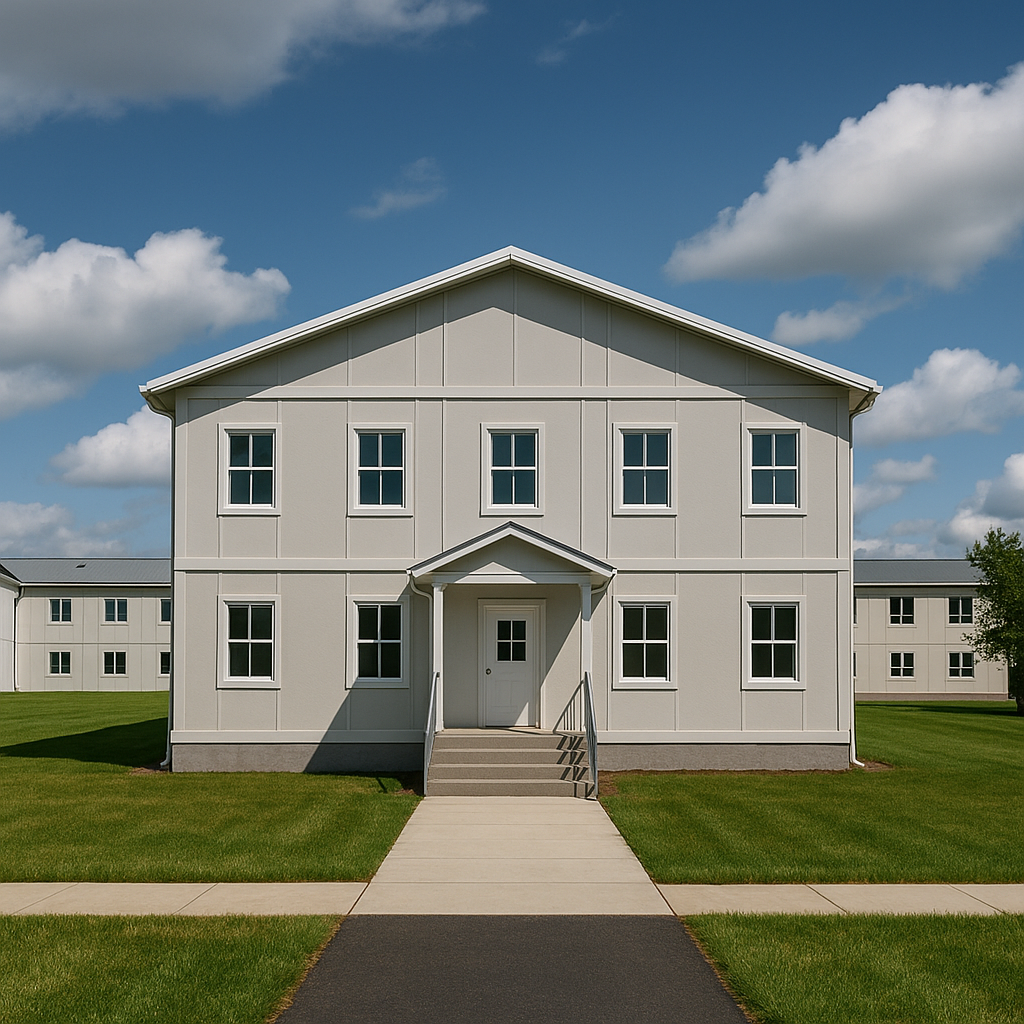
What Are Prefabricated Administrative Buildings
They are office facilities designed as volumetric modules or panelised systems manufactured in a controlled environment, then transported and assembled on site. Packages can be frame-only, frame plus envelope, or turnkey solutions with interior fit-out, ICT, furniture and signage. Because much of the fabrication occurs off-site, programmes can move from concept to occupancy in a shorter timeframe than conventional concrete or masonry builds.
- Structural systems: light steel, engineered timber or hybrid frames sized for spans, loads and potential future floors.
- Envelopes: insulated sandwich panels or high-performance façades targeting thermal comfort and energy efficiency.
- Interiors: demountable partitions, acoustic solutions, washable finishes and raised floors for services.
- Services: integrated HVAC, low-energy lighting, data cabling and security systems.
Why They Matter Today
Rapid deployment
Organizations facing expansion, relocation or programme deadlines benefit from fast delivery. Modular complexes can be operational within weeks for smaller scopes and months for larger multi-storey blocks.
Flexible space planning
Open-plan zones can be combined with quiet rooms and meeting suites; demountable partitions allow re-stacking without major works.
Predictable budgets
Factory workflows reduce variability and waste. Clear scopes help control risk, even though compliance and logistics still shape totals.
Workplace quality
Daylight, acoustics, thermal comfort and ergonomics support productivity and staff wellbeing when specified correctly.
Compliance
Reputable suppliers design for fire safety, accessibility and workplace health standards, aligning with local approvals.
Core Design Features
- Professional façades: composite cladding or curtain walling for a civic or corporate identity.
- Entrance and reception: secure lobbies with visitor management and accessibility features.
- Acoustic comfort: partition build-ups, ceiling treatments and floor systems planned for speech privacy.
- Meeting suites: rooms sized for workshops, hybrid conferencing and confidential sessions.
- Support spaces: copy/print hubs, tea points, storage and wellness rooms to reduce distractions.
- Future-proofing: structural allowances for extra bays or floors; spare capacity in plant and distribution.
Typical Applications
- Public administration: town halls, service centres, tax or licensing offices and court annexes.
- Corporate offices: headquarters, satellite hubs and project war-rooms.
- Education and research: campus administration, admissions and grant management suites.
- Programme management: on-site admin hubs for major infrastructure and regeneration projects.
Advantages Over Traditional Offices
- Speed: reduced on-site disruption and faster occupation.
- Consistency: factory-controlled quality assurance and repeatable details.
- Scalability: add modules as teams grow or programmes change.
- Relocatability: some solutions can be dismantled and moved to new sites.
- Cleaner sites: fewer deliveries, less waste and shorter noisy periods in busy neighbourhoods.
Cost Drivers and Budget Planning
Modular offices can be cost-effective, but totals vary with scope and location. Key drivers include:
- Size and geometry: larger spans, higher eaves or extra floors increase structure and plant.
- Envelope and finish: performance panels, façade articulation and interior quality levels.
- ICT and security: networks, access control, CCTV and hybrid meeting technology.
- Compliance: accessibility, fire strategy, acoustic benchmarks and documentation.
- Logistics: transport distance, crane access, street closures and delivery windows.
- Groundworks and utilities: foundations, drainage, power and data connections.
From Brief to Handover
- Brief and feasibility: define headcount, adjacencies, meeting ratios and accessibility requirements.
- Concept and coordination: structural grids, vertical circulation, MEP routing and fire strategy.
- Factory production: frames, panels and service modules fabricated with quality control.
- Site preparation and logistics: foundations, permits, crane planning and delivery sequencing.
- Assembly and enclosure: erection of frames, installation of roofs, walls and openings.
- Fit-out and commissioning: ceilings, floors, furniture, ICT and systems testing before occupation.
Sustainability and Wellbeing
- Fabric-first efficiency: insulation, airtightness and thermal bridge control lower operational energy.
- Renewables readiness: roofs suitable for solar PV; efficient heat pumps and heat recovery ventilation.
- Material responsibility: recyclable steel and low-VOC finishes for healthier interiors.
- Wellbeing: daylight access, glare control, thermal stability and acoustic privacy to support focus.
Challenges and Mitigations
- Perception of temporariness: communicate design life, warranties and maintenance strategy.
- Urban logistics: coordinate deliveries, cranes and neighbourhood notifications to minimise disruption.
- Customization limits: use standard modules for most areas; target bespoke features where they matter most.
- Maintenance: plan inspections for roof drainage, sealants, HVAC filters and fixings.
Conclusion
Prefabricated administrative buildings combine factory quality with on-site speed to create professional, flexible workplaces. Whether for municipalities, agencies or corporate teams, modular offices shorten delivery times, reduce disruption and provide space that can grow with the organisation. With a clear brief, robust scope definition and the right supplier, prefabrication is a practical route to modern administration facilities in 2025.


