




















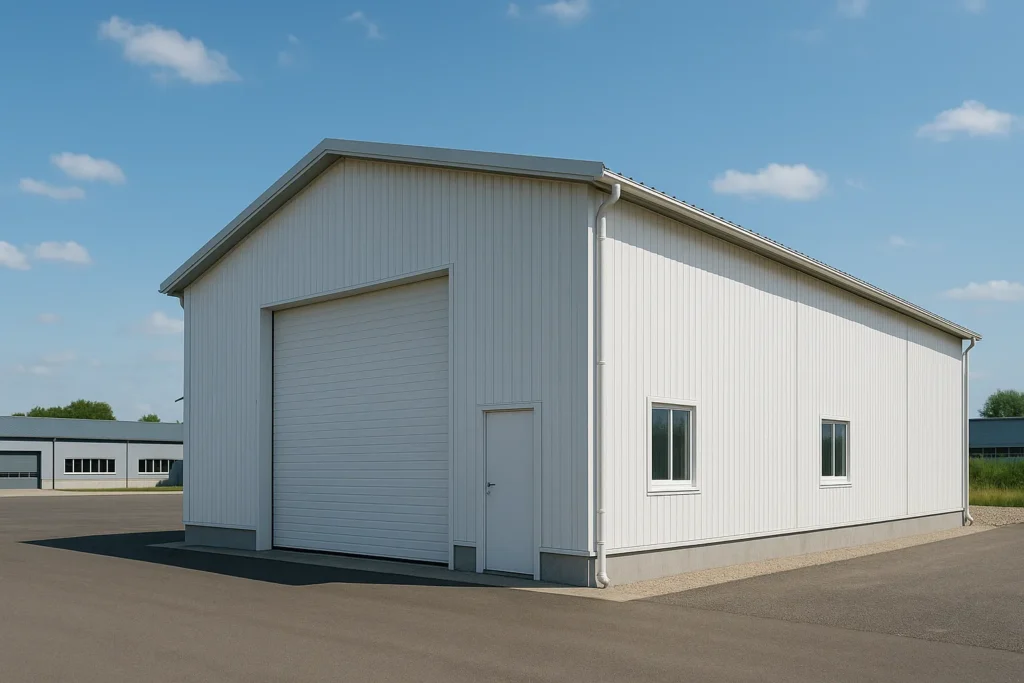
Light Steel Industrial Structures for Contemporary Manufacturing 2025
Manufacturers, logistics firms and e-commerce operators need facilities that can be delivered quickly and adapted just as fast. Light steel systems meet this need by pairing factory precision with efficient on-site assembly. Unlike one-off builds, modern industrial buildings in light steel are planned as platforms—ready for mezzanines, conveyor lines, automated storage and future extensions without major disruption.
Why Light Steel for Industrial Buildings
- Speed to operation: repetitive frames and prefabricated components shorten programmes and reduce finance carrying costs.
- Clear spans: tapered portal frames and trusses create wide, column-free bays for racking, robotics and forklifts.
- Strength to weight: high strength sections deliver performance with less material, easing foundations and logistics.
- Envelope performance: insulated sandwich panels and rooflights balance thermal efficiency with daylight for safer, more comfortable floors.
Design Considerations that Matter
- Crane and point loads: plan for overhead bridge cranes, monorails or jib cranes early; include runway beams and deflection criteria.
- Fire and insurance: coordinate structural fire strategy, ESFR or high-bay sprinklers, compartmentation and smoke vents with insurer requirements.
- Pavement and racking: floor flatness/levelness for VNA aisles, joint layout, and load transfer under rack legs prevent settlement issues.
- Ventilation and IAQ: combine displacement ventilation with destratification fans to even temperatures in tall volumes.
- Acoustic zoning: separate noisy processes from offices with acoustic liners and buffer corridors.
- Power and data backbone: busbars, tray routes and spare capacity for future automation and EV fleets.
Digital coordination (BIM) reduces clashes between process equipment, services and structure, while enabling accurate bills of quantities and faster approvals.
Operations and Future Expansion
High-performing facilities are designed for change. Common future-proofing moves include:
- Knock-out portals: pre-engineered openings in gable walls for later bay additions.
- Mezzanine readiness: columns and footings sized for a second-tier office or pick tower.
- Flexible docks: adjustable dock levellers and canopies for changing trailer fleets.
- Roof live load: allowance for solar PV, walkways and maintenance equipment.
For harsh interiors (food, chemicals, galvanizing), select liners and fixings compatible with cleaning agents and vapours, and detail thermal breaks to avoid condensation on cold bridges.
Lifecycle Costs and Value
Lowest first cost is not always lowest total cost. A practical approach to industrial buildings weighs:
- Capex: frame type, bay spacing, crane allowance, panel specification and dock equipment.
- Opex: heating/cooling loads, air changes, lighting (LED + controls) and rooflight maintenance.
- Downtime risk: resilient details at door thresholds, durable floor joints and protected corners reduce repairs.
- Embodied/operational carbon: specify recycled steel content, efficient envelopes and PV to meet ESG targets and incentives.
A clear employer’s requirement document (ERD) avoids scope gaps—state whether offers include foundations, fire systems, offices, yard lighting and permits.
FAQ
Are light steel industrial buildings permanent? Yes. With the right coatings and maintenance regime, design life can span multiple decades.
Can they support heavy process loads? Frames are engineered for crane loads, suspended utilities and rooftop PV—verify early to optimise member sizes.
Do they perform in cold or hot climates? Insulated panels, thermal breaks and destratification fans stabilise temperatures across seasons.
How fast can a facility go live? Smaller hubs may open in weeks; large cross-dock or production halls need additional time for services and commissioning.
Conclusion
Light steel makes industrial buildings faster to deliver, easier to adapt and more efficient to operate. By aligning span strategy, envelope performance, fire safety and expansion planning from day one, businesses secure facilities that work today—and remain upgrade-ready for tomorrow’s automation and energy goals.


