




















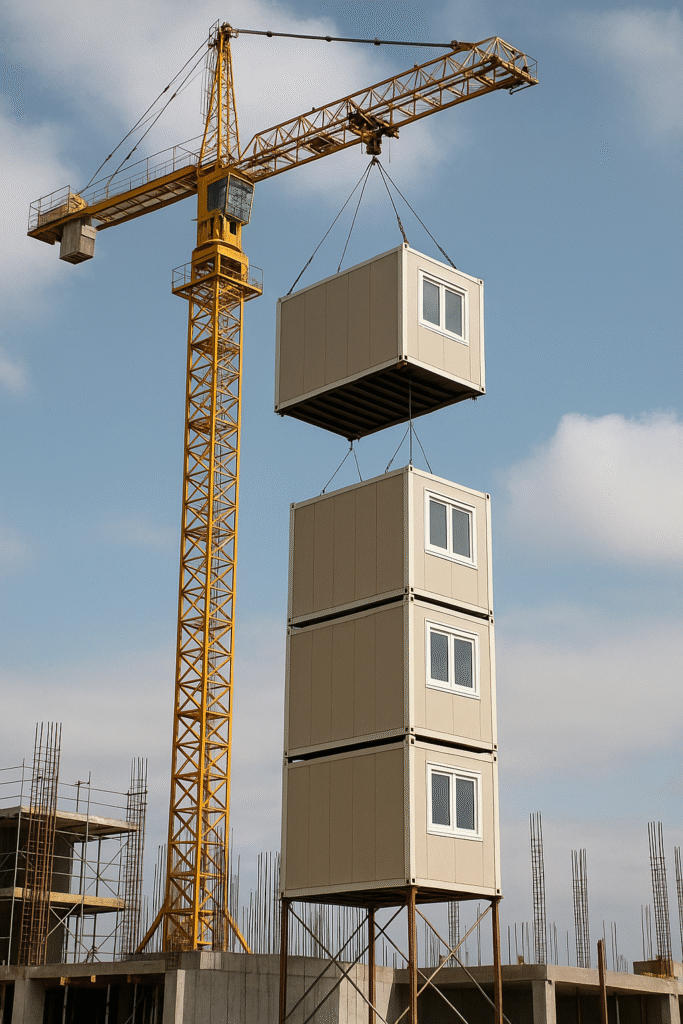
The Concept of Stacking Prefabricated Units
Stacking refers to placing prefabricated modules one on top of another, creating multi-story structures.
This approach maximizes land use and allows for vertical expansion without requiring additional ground space.
Stacking is widely used in:
- Worker dormitories and camps
- Office complexes
- Educational facilities
- Emergency and disaster relief housing
Engineering Considerations
Although prefabricated units can be stacked, it is crucial to follow certain structural rules:
- Load-Bearing Capacity: Each unit must be designed with strong steel frames capable of carrying the weight of additional floors.
- Foundation Strength: A reinforced and properly leveled foundation is essential to ensure stability.
- Connection Systems: Secure interlocking and fastening systems prevent shifting and ensure structural integrity.
- Height Limits: Depending on the design, prefabricated buildings can typically reach 2–4 stories safely. Larger projects may require special engineering.
Advantages of Stacked Prefabricated Units
1. Efficient Land Use
By stacking units vertically, businesses and communities can maximize limited land space, especially in urban areas or crowded project sites.
2. Scalability
Stacked units allow for future expansion. Companies can start with single-story units and expand vertically as their needs grow.
3. Cost-Effectiveness
Instead of acquiring more land, stacking makes it possible to expand capacity on the same footprint, saving both money and resources.
4. Functionality
Stacked prefabricated structures can be customized with staircases, corridors, and balconies, providing the same comfort and utility as conventional multi-story buildings.
Common Applications
Stacking is widely used in construction sites where worker accommodations and offices need to be compact yet functional. In disaster relief, stacked units create efficient housing camps. Educational and healthcare facilities also benefit from vertical modular solutions, ensuring fast deployment in limited spaces.
Conclusion
So, can prefabricated units be stacked? Absolutely. With the right engineering, foundation, and connection systems, prefabricated buildings can be safely and efficiently built as multi-story structures. This solution offers scalability, cost savings, and maximum land efficiency—making prefabricated units a smart choice for both temporary and permanent projects.


